
Jun 14, 2022
Keith Ransom-Kehler with Zikrullah Khadem
Jun 13, 2022
Need to understand meanings behind symbols in Christianity
Some Christians claim that the Holy Ghost descended after the resurrection of the Christ and that Christ is alluding to this. But as the Holy Ghost was always with …Christ, is this logical? Again he says, "He will guide you unto truth," “He will be better for you than I”, He adds, "Until I go, he cannot come." Endeavor to understand the divine words, otherwise difficulties will arise. Had the Jews understood symbology, they would have understood the Christ. The holy books are full of significance and must never be taken literally. Elijah also was expected to come from heaven, and … Christ said, "Elijah is none other than John the Baptist." The reality of John was in the supreme concourse. It is essential to have divine perception in order to see the truth, to hear the call, and obey -- liberating the hearts from all earthly attachment.
- ‘Abdu'l-Baha (From a talk, ‘Divine Philosophy’)
Jun 12, 2022
Creating stories from the Dawn-Breakers for children

Such stories regarding the life of different prophets together with their sayings will also be useful to better understand the literature of the Cause for there is constant reference to them. It is however the work of experienced people to bring together such materials and make of them interesting text books for the children.
- Shoghi Effendi (From a letter dated 19 October 1932 written on behalf of Shoghi Effendi to a Local Spiritual Assembly and a State Teaching Committee; The Compilation of Compilations vol. I)
Jun 11, 2022
“a fermentation in the general life of mankind”
Itself [the Faith] undergoing a period of incubation during its primitive age, it has, through the emergence of its slowly-crystallizing system, induced a fermentation in the general life of mankind designed to shake the very foundations of a disordered society, to purify its life-blood, to reorientate and reconstruct its institutions, and shape its final destiny.
- Shoghi Effendi (Preface to ‘God Passes By’)
Jun 10, 2022
Bahá'u'lláh's ancestral home in Takur, in the district of Nur

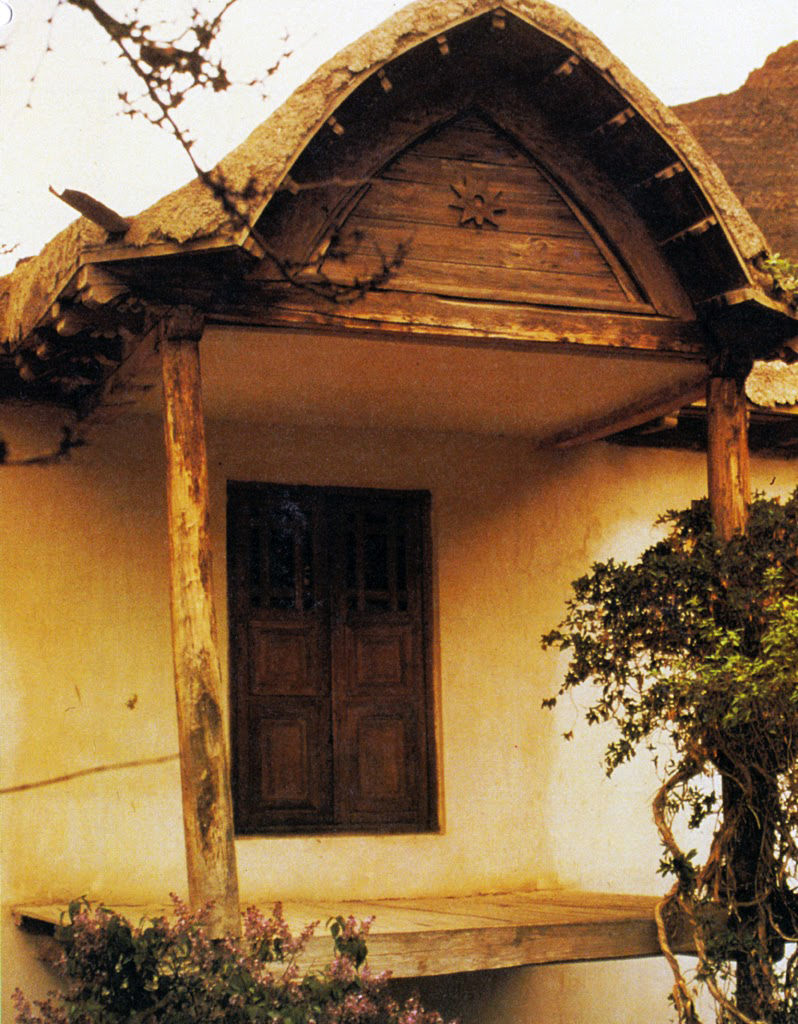
Baha’u’llah usually spent His summers as a boy at his
ancestral home in Takur. He also visited it later in life before being exiled
from Iran.
Jun 9, 2022
Nabil: - the Author of Dawn-Breakers

He was present in 'Akká when Bahá'u'lláh passed away in 1892 and soon after was so overcome with grief that he drowned himself in the sea. His body was found along the shore and was buried in the cemetery of 'Akká. 'Abdu'l-Bahá is reported to have been struck with deep sorrow at the manner of his death. He states in his narration that he met the maternal uncle of the Báb, Haji Mirza Siyyid Ali who had visited his nephew in the Castle of Chihriq and had recently returned to Tihran. He started writing his narrative in 1305 A.H. four years before the passing of Bahá'u'lláh. It took him about a year and half to write it. His chief informants were Mirza Ahmad the amanuensis of the Báb and Mirza Musa the brother of Bahá'u'lláh. Parts of his narrative were read in the presence of Bahá'u'lláh and approved by Him. 'Abdu'l-Bahá also went over sections of his narrative....
- Shoghi Effendi
(From a letter dated 30 November 1930, written on behalf of Shoghi
Effendi; 'The Unfolding Destiny of the British Baha'i Community')
Jun 8, 2022
Who is a "saint"?
We call people "saints" who have achieved the highest degree of mastery over their egos.
- Shoghi Effendi (From a letter written on behalf of Shoghi Effendi, ‘Unfolding Destiny’)
Jun 7, 2022
The date of the Báb’s birth fulfilled a saying attributed to Imám ‘Alí

- Nabil (‘The
Dawn-Breakers’, translated and edited by Shoghi Effendi)
Jun 6, 2022
1912: ‘Abdu’l-Baha in Washington D.C., USA

'Abdu'l-Baha with Yusuf Diya Pasha, the Turkish Ambassador
left, and Siyyid Asadu'llah-i-Qumi, center
Jun 5, 2022
Purpose of Religion
Religion should be the means of good fellowship and love. It must upraise the standard of harmony and solidarity. If religion is conducive to hatred and enmity, its existence is harmful to the welfare of the community.
- 'Abdu'l-Baha (Utterances of ‘Abdu’l-Baha recorded by Isabel Fraser Chamberlain; ‘Divine Philosophy’, 1928)
Jun 4, 2022
The significance of twin things in the Cause

- Hand of the Cause Dhikru’llah Khadem (‘The Vision of Shoghi
Effendi’, Proceedings of the Association for Baha'i Studies, Ninth Annual
Conference, November 2-4, 1984, Ottawa, Canada)
[1] Shoghi Effendi, Messages to the Bahai' World 1950-1957:
"Greatly enhanced international endowments in Holy Land in twin cities of
Acre and Haifa, now include twin Holy Shrines situated on plain of Acre and
slope of Mount Carmel; twin Mansions of Bahji and Mazra'ih, twin historic
Houses inhabited by Baha'u'llah and ‘Abdu’l-Baha; twin International Archives
adjoining the Bab's Sepulcher and the resting-place of the Greatest Holy Leaf;
twin Pilgrim Houses, constructed for Oriental and Occidental pilgrims; twin
Gardens of Ridvan and Firdaws, associated with the memory of the Author of the
Baha'i Dispensation."
Jun 3, 2022
‘Abdu’l-Baha explains the “four stations” embedded in the Islamic Tradition: "I was a Hidden Treasure and loved to be known. Therefore I created the Creation that I might be known."
Know, O bird of the flower-garden of Divine Unity and nightingale of the garden of detachment! that in order to comprehend this Tradition: "I was a Hidden Treasure and loved to be known Therefore I created the Creation that I might be known", it is necessary to understand four stations. This Tradition is upon the tongues of all people, be they of the generality or of special rank, and is written in all the books and treatises. As for understanding these four stations, the first is "the Hidden Treasure"; the second is the stages and stations of "Love"; the third is the station of "Creation" and similar matters; and the fourth is the station of "Knowledge".
- ‘Abdu’l-Baha (‘Tafsír-i-Hadith-i-Kuntu
Kanzan Makhfíyyan’ – provisional translation)
Jun 2, 2022
Book: Selections From The Writings of the Báb

In the preface to this book we read:
“The Baha'i Community has long awaited the day when a comprehensive selection from the writings of the Báb would be made available to it. Ever since Shoghi Effendi translated and published Nabil's Narrative, and set forth in his monumental works the exalted station of the Báb, the Baha'is the world over, and particularly those in the West, have, in their longing to draw nearer to the glorious spirit of Him Who was not only the Herald of their Faith but the Bearer of an independent Revelation, eagerly anticipated an authentic compilation of His revealed utterances and writings. This volume, it is hoped, will be an initial and effective step in that direction.
In view of the vastness of the writings of the Bab, a thorough review of His several works was required. The Universal House of Justice entrusted this task to its Research Department. The actual translation was made by Mr. Habib Taherzadeh, who for several years himself served in that Department. With the assistance of a committee which worked with him, this work is now completed, and it is being made available to Baha'is and the general public as a precious addition to the volume of Baha'i literature in the English language.”
The Table of Contents shows the following:
Tablets and Addresses
Excerpts from the Qayyumu’l-Asma
Excerpts from the Persian Bayan
Excerpts from the Dala’il-i-Sab’ih (The Seven Proofs)
Excerpts from the Kitab-i-Asma (The Book of Names)
Excerpts from Various Writings
Prayers and Meditation
Notes
The book has 236 pages. It provides a rare and precious opportunity for us to become exposed to the Teachings of the Bab, “the King of the Messengers” (Baha’u’llah, Tablet of Ahmad).
Jun 1, 2022
To “manifest such attributes and ethical conduct as to embody and personify the teachings of Bahá'u'lláh”
… in this cycle of Bahá'u'lláh verbal confessions and acknowledgements, literal faith and certainty and external relations are of no avail. Nay, rather, the beloved of God and the maid-servants of the Merciful must manifest such attributes and ethical conduct as to embody and personify the teachings of Bahá'u'lláh. They must promulgate the law of the Kingdom with deeds and not words. Thus may they become the quintessence of being, the signs of the Kingdom of God, standards of the Supreme Concourse. May ye be salutary water for the thirsty, an evidence of guidance for the seeker, protection and support for the helpless, a shelter and home for the wanderers, the treasury of the Kingdom for the poor; the source of hope and happiness for the disappointed; the remedy of the heart and soul for the ailing. May you manifest the utmost of kindness to the human race; to weep with him who mourneth and to laugh with him who rejoiceth; sympathizing with the helpless; in communion with the wanderer; a friend to the friend and foe.
- ‘Abdu'l-Baha (Star of the West, vol. 1, no. 4, May 17, 1910)
May 31, 2022
A prayer for believers: - Protection; Receiving God's nourishment
Glorified art Thou, O Lord my God! Every man of insight confesseth Thy sovereignty and Thy dominion, and every discerning eye perceiveth the greatness of Thy majesty and the compelling power of Thy might. The winds of tests are powerless to hold back them that enjoy near access to Thee from setting their faces towards the horizon of Thy glory, and the tempests of trials must fail to draw away and hinder such as are wholly devoted to Thy will from approaching Thy court.
Methinks, the lamp of Thy love is burning in their hearts, and the light of Thy tenderness is lit within their breasts. Adversities are incapable of estranging them from Thy Cause, and the vicissitudes of fortune can never cause them to stray from Thy pleasure.
I beseech Thee, O my God, by them and by the sighs which their hearts utter in their separation from Thee, to keep them safe from the mischief of Thine adversaries, and to nourish their souls with what Thou hast ordained for Thy loved ones on whom shall come no fear and who shall not be put to grief.
- Baha’u’llah
(‘Prayers and Meditations by Baha’u’llah’)
May 30, 2022
1910: Some early believers in the United States

May 29, 2022

May 28, 2022
As a child, Baha’u’llah was a little short in stature
It is related that one day, when Baha’u’llah was seven years old, as He was walking His parents were watching Him, and His mother remarked that He was a little short in stature. His father replied: 'That matters not. Do you not know how intelligent He is and what a wonderful mind He has!'
- Balyuzi (‘Baha’u’llah, The King of Glory’)
May 27, 2022
What people “of insight” and those with “discerning eye” can perceive
Every man of insight confesseth Thy sovereignty and Thy dominion, and every discerning eye perceiveth the greatness of Thy [God's] majesty and the compelling power of Thy might.
- Baha’u’llah (‘Prayers and meditations by Baha’u’llah’)
May 26, 2022
The world of dream is a proof of the existence of the soul

- Baha’u’llah ('Gleanings from the Writings of Baha’u’llah'; Compilation ‘Reincarnation and the Nature and Progress of the Soul’, prepared by the Research Department of the Universal House of Justice)
May 25, 2022
“Love manifests its reality in deeds, not only in words”

There are many ways of expressing the love principle; there is love for the family, for the country, for the race, there is political enthusiasm, there is also the love of community of interest in service. These are all ways and means of showing the power of love. Without any such means, love would be unseen, unheard, unfelt—altogether unexpressed, unmanifested!... it is necessary to have an instrument, a motive for love’s manifestation, an object, a mode of expression.
- ‘Abdu’l-Baha (From
a talk; ‘Paris Talks: Addresses given by ‘Abdu’l-Bahá in Paris in 1911-1912’)
May 24, 2022
Individual preparation for teaching the Faith
... become ye sanctified above and purified from this world and the inhabitants thereof; suffer your intention to become for the good of all; cut your attachment to the earth and like unto the essence of the spirit become ye light and delicate. Then with a firm resolution, a pure heart, a rejoiced spirit, and an eloquent tongue, engage your time in the promulgation of the divine principles...
- ‘Abdu’l-Bahá (‘Tablets of the Divine Plan’)
May 23, 2022
Mulla Husayn
Mulla Husayn, the first Letter of the Living, surnamed the Bábu'l-Báb (the Gate of the Gate); designated as the "Primal Mirror;" on whom eulogies, prayers and visiting Tablets of a number equivalent to thrice the volume of the Qur'án had been lavished by the pen of the Báb; referred to in these eulogies as "beloved of My Heart;" the dust of whose grave, that same Pen had declared, was so potent as to cheer the sorrowful and heal the sick; whom "the creatures, raised in the beginning and in the end" of the Bábí Dispensation, envy, and will continue to envy till the "Day of Judgment;" whom the Kitáb-i-Íqán acclaimed as the one but for whom "God would not have been established upon the seat of His mercy, nor ascended the throne of eternal glory;" to whom Siyyid Kazim had paid such tribute that his disciples suspected that the recipient of such praise might well be the promised One Himself …
- Shoghi Effendi
(‘God Passes’)
May 22, 2022
Condition of Persia at the time of the appearance of the Báb
Persia, the birthplace of the Bahá’í Revelation, has
occupied a unique place in the history of the world. In the days of her early
greatness she was a veritable queen among nations, unrivaled in civilization,
in power and in splendor. She gave to the world great kings and statesmen,
prophets and poets, philosophers and artists. Zoroaster, Cyrus and Darius,
Háfiz and Firdawsí, Sa‘dí and ‘Umar Khayyám are but a few of her many famous
sons. Her craftsmen were unsurpassed in skill; her carpets were matchless, her
steel blades unequaled, her pottery world famous. In all parts of the Near and
Middle East she has left traces of her former greatness.
Entrance to ancient city of Saveh, circa 1900
Yet, in the eighteenth and nineteenth centuries she had sunk to a condition of deplorable degradation. Her ancient glory seemed irretrievably lost. Her government was corrupt and in desperate financial straits; some of her rulers were feeble, and others monsters of cruelty. Her priests were bigoted and intolerant, her people ignorant and superstitious. Most of them belonged to the Shí‘ih sect of Muhammadans, but there were also considerable numbers of Zoroastrians, Jews and Christians, of diverse and antagonistic sects. All professed to follow sublime teachers who exhorted them to worship the one God and to live in love and unity, yet they shunned, detested and despised each other, each sect regarding the others as unclean, as dogs or heathens. Cursing and execration were indulged in to a fearful extent. It was dangerous for a Jew or a Zoroastrian to walk in the street on a rainy day, for if his wet garment should touch a Muhammadan, the Muslim was defiled, and the other might have to atone for the offense with his life. If a Muhammadan took money from a Jew, Zoroastrian or Christian he had to wash it before he could put it in his pocket. If a Jew found his child giving a glass of water to a poor Muhammadan beggar he would dash the glass from the child’s hand, for curses rather than kindness should be the portion of infidels! The Muslims themselves were divided into numerous sects, among whom strife was often bitter and fierce. The Zoroastrians did not join much in these mutual recriminations, but lived in communities apart, refusing to associate with their fellow countrymen of other faiths.
May 21, 2022

Subscribe to:
Posts (Atom)